NVDIAG at the CEEVEC Matching Day 2

NVDIAG at the Heart of Extracellular Vesicle Research
On March 26, 2026, the NVDIAG LabCom team was proud to participate in the Matching Day #2 of the CEEVEC Action, organized by Cancéropôle PACA at the Palais du Pharo in Marseille. This landmark scientific event brought together the regional extracellular vesicle (EV) community around three key themes: oncology, therapeutics, and technological innovation.
NVDIAG was represented by Alain Roussel and Clara Bouyx (LISM, CNRS-UMR 7255), alongside the lab’s young researchers, who presented the latest advances from our collaborative projects with BioCytex.
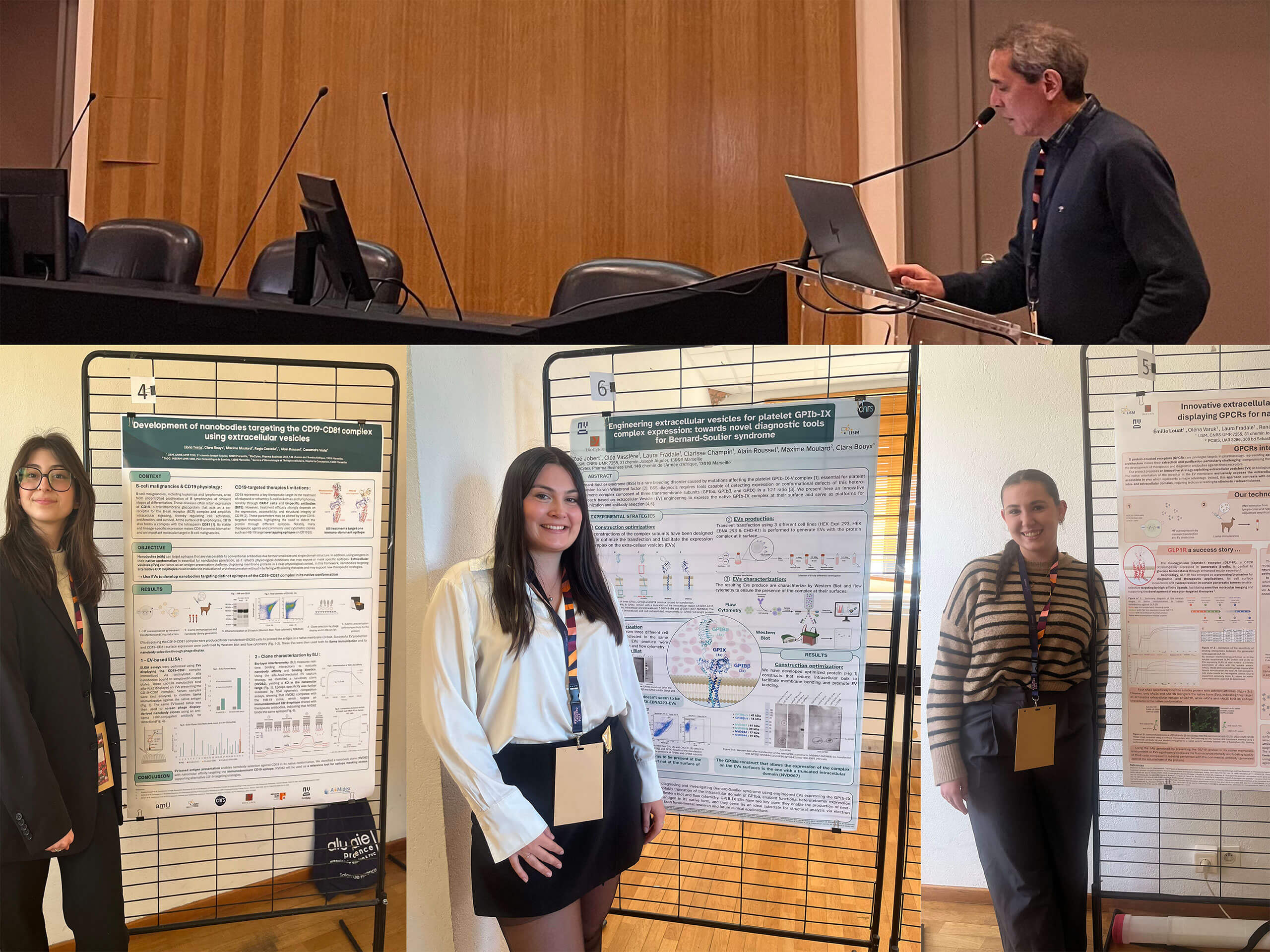
Oral communication – Alain Roussel
Characterization of antibody/membrane antigen interactions on extracellular vesicles by Bio-Layer Interferometry (BLI) using the Octet R8e Cassandre Vedel, Cléa Vessière, Laura Fradale, Clara Bouyx & Alain Roussel – LISM-CNRS, Marseille
Most cell surface markers are membrane proteins (MPs) whose study in vitro is typically approached through soluble extracellular domains or detergent extraction — both methods that disrupt native conformation and lipid environment. Extracellular vesicles offer a compelling alternative by preserving membrane proteins in a near-physiological context.
Within the NVDIAG LabCom framework, EVs displaying MPs of interest are used to immunize llamas and generate nanobodies. A key technical challenge was the large size mismatch between EVs (~100 nm, several million Da) and the nanobodies they interact with (~15 kDa) — a difference that had previously limited characterization by Bio-Layer Interferometry. The significantly improved sensitivity of the new Octet® R8e instrument now makes it possible to overcome this barrier and measure antibody/antigen interactions directly on EV surfaces. Results across several NVDIAG projects were presented and discussed.
Poster Presentations
Poster 1 – Ilona Testa et al. Development of nanobodies targeting the CD19–CD81 complex using extracellular vesicles
Ilona Testa presented a strategy to generate nanobodies against CD19 in its native membrane conformation using EVs displaying the CD19–CD81 complex, produced from transfected HEK293 cells. One nanobody clone (NVD82) was identified with nanomolar affinity (KD = 2.5 nM), targeting the immunodominant CD19 epitope shared with current therapeutic antibodies such as CAR-T and BiTE agents — positioning it as a key reference tool for epitope masking assays and alternative CD19-targeting strategies in B-cell malignancies.
Poster 2 – Émilie Louat et al. Innovative extracellular vesicle platform displaying GPCRs for nanobody generation
Émilie Louat presented NVDIAG’s EV-based platform applied to G protein-coupled receptors (GPCRs), a pharmacologically privileged but notoriously difficult-to-handle class of targets. Using the GLP-1R receptor as a proof of concept, EVs were used to immunize llamas and select nanobodies that recognize the receptor’s native conformation with higher affinity than commercial antibodies — opening new avenues for pancreatic cancer diagnostics and targeted therapies. The approach is now being extended to the Adenosine A2A receptor (AA2A), an immune checkpoint of high oncological interest.
Poster 3 – Zoé Jobert et al. Engineering extracellular vesicles for platelet GPIb-IX complex expression: towards novel diagnostic tools for Bernard-Soulier syndrome
Zoé Jobert presented an optimized strategy for expressing the native GPIb-IX heterotetrameric complex at the surface of engineered EVs, with the goal of developing new diagnostic and research tools for Bernard-Soulier syndrome (BSS), a rare inherited platelet disorder. Truncation of the intracellular domain of GPIbα (construct NVD067) was identified as the key optimization enabling functional surface expression on HEK Expi293-derived EVs, validated by Western blot and flow cytometry. These EVs serve as versatile platforms for both next-generation nanobody production and structural analysis by electron microscopy.
Supported by: ANR · CNRS · Aix-Marseille Université · Région Sud · BioCytex