Extracellular Vesicles: A Revolution in Membrane Protein Targeting

New data published by the Laboratory of Macromolecular Systems Engineering (LISM) and the Paris Institute of Ecology and Environmental Sciences (iEES-Paris) validate a unique expertise in generating nanobodies (VHH) against complex membrane targets.
A Collaboration of Excellence Driving Innovation
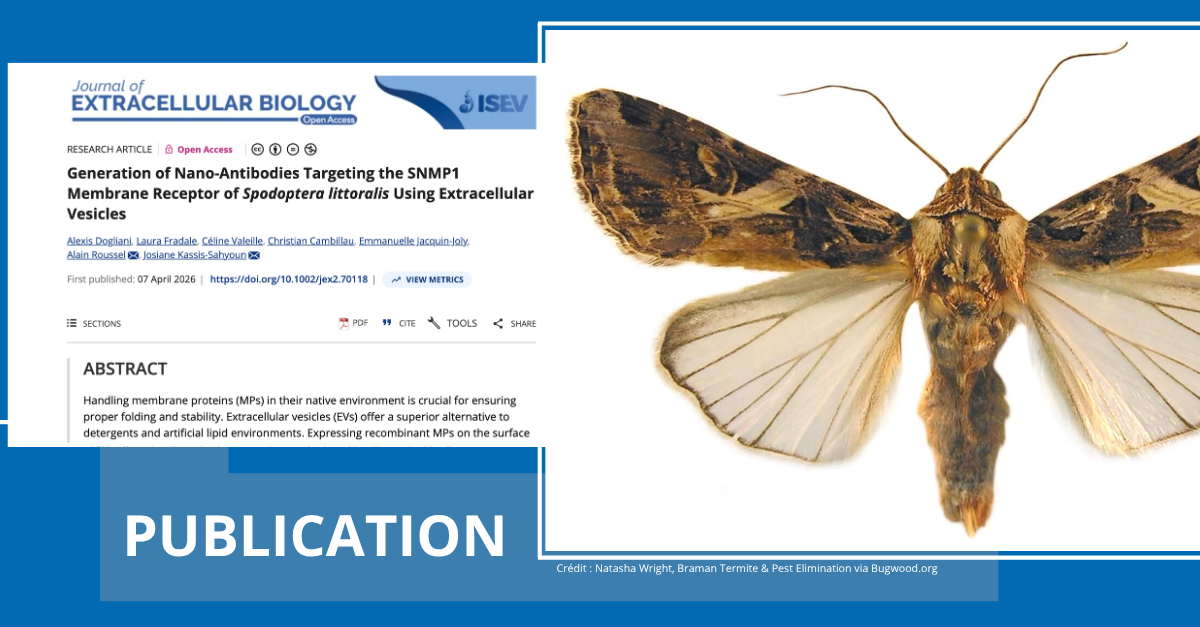
A major study, published in 2026 in the Journal of Extracellular Biology, validates a unique expertise and know-how for generating nanobodies from extracellular vesicles—a technology at the heart of the LabCom NVDIAG’s activities. This work is the result of a synergy between LISM (CNRS / Aix-Marseille University) and iEES-Paris (INRAE / Sorbonne University / CNRS / IRD / UPEC / Université Paris Cité). The project was coordinated by Alain Roussel (LISM) and Josiane Kassis-Sahyoun (LISM/iEES-Paris), in collaboration with Emmanuelle Jacquin-Joly (iEES-Paris).
The Scientific Challenge: « Taming » Membrane Proteins
Membrane proteins are key targets in modern medicine and biology, but their natural hydrophobicity makes them extremely challenging to study. To overcome this obstacle, researchers use extracellular vesicles (EVs) as biological « display platforms. » Expressing the target protein directly on the surface of these lipid bubbles preserves its natural structure, offering a decisive advantage: target preparation in just one week, with optimal stability and native conformation.
Membrane proteins are key targets in modern medicine and biology, but their natural hydrophobicity makes them extremely challenging to study. To overcome this obstacle, researchers use extracellular vesicles (EVs) as biological « display platforms. » Expressing the target protein directly on the surface of these lipid bubbles preserves its natural structure, offering a decisive advantage: target preparation in just one week, with optimal stability and native conformation.
A Biocontrol Objective: Disrupting Pest Reproduction
In this study, the target protein is SNMP1, a key receptor involved in the detection of sex pheromones in the pest insect Spodoptera littoralis. The goal is to develop nanobodies capable of blocking this receptor to disrupt chemical communication between insects. By preventing mating, this approach offers an innovative and environmentally friendly biocontrol strategy to limit the reproduction of pest populations in agriculture.
Technological Innovation: The « Multi-Layer » Strategy
The major contribution of this work lies in the development of a multi-layer anchoring strategy. By co-expressing a universal anchor protein (ALFA-ACE2) with the target, EVs can be easily immobilized on various surfaces such as ELISA plates or biosensors. This method enabled the isolation of nano-antibodies with exceptional nanomolar affinity (down to 0.617 nM), characterized using cutting-edge Bio-Layer Interferometry (BLI) technology.
Experimental Validation for Future NVDIAG LabCom Developments
While demonstrated on an insect receptor, this technology drives NVDIAG’s human health program:
Reliability: EVs provide a native environment under physiological membrane conditions, unlike detergents and other biochemical techniques used for extracting and stabilizing membrane proteins.
Guaranteed Specificity: The multi-layer technology ensures specific anchoring and secures the selection of nanobodies against original epitopes.
Universal Platform: The approach is currently being validated for a wide range of human therapeutic and diagnostic targets.
This work was supported by the French National Research Agency (ANR) (projects ANR-20-CE20-0003-01 & 02) and benefited from the infrastructure of the Laboratory of Architecture and Function of Biological Macromolecules (AFMB) and the French Infrastructure for Integrated Structural Biology (FRISBI).